jueves, junio 13, 2013

ASOQUIMBO´s land liberations start to spread roots


It’s been two months since members of the Association of Affected Peoples of the Quimbo Hydroelectric Project (ASOQUIMBO), started liberating lands on the farms along the road that connects La Jagua with Villa Fernanda that belong to multinational company Emgesa-Endesa-Enel. These new actions, in defense of the territory and rights of the affected population, have received various police notifications of imminent removal of those on the lands, attempted infiltrations by Emgesa-Endesa-Enel, almost daily flyovers of helicopters, and the militarization of the territory with the permanent presence of anti-disturbance police, ESMAD, as a tactic of intimidation.
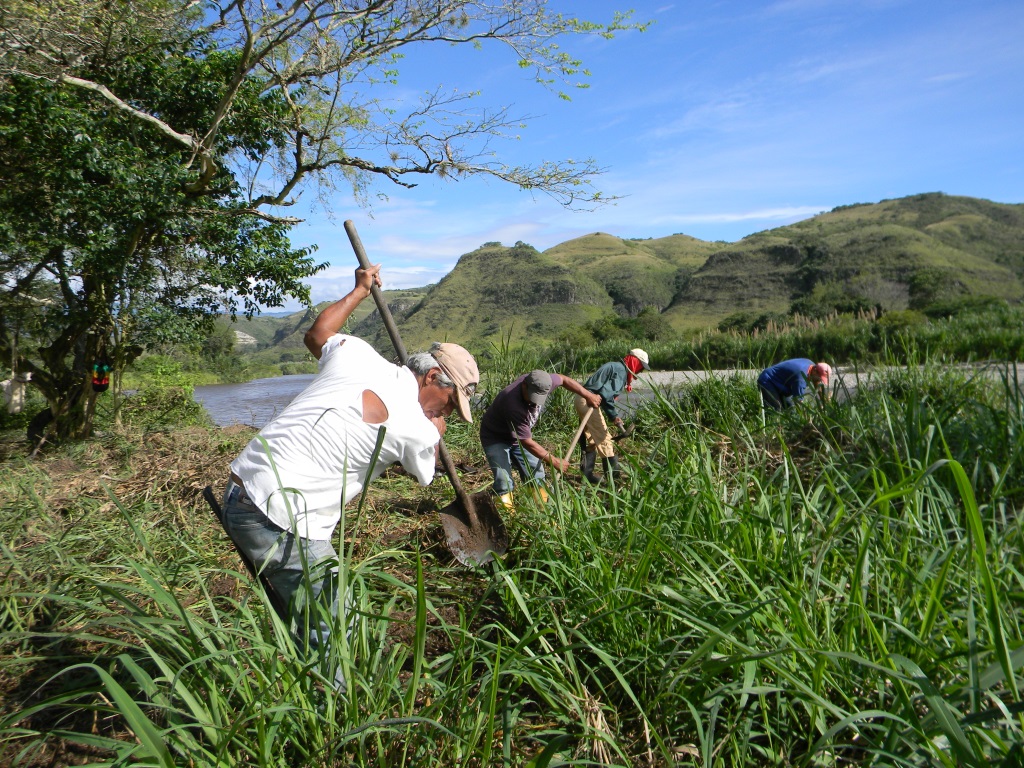
Nonetheless, the communities continue to insist and demand that what they need as development is not more dams, but a Campesino Reserve that produces food. Daily activities that folks are engaged in include repairing the abandoned houses, cleaning vegetation with machetes, creating composts and natural fertilizers, and planting crops for consumption and for sale. Before the first month on the land had past there were already seeds of beans, yucca, corn, pumpkin and cilantro in the ground and germinating from the rich earth. "We want to live from these lands as we always have, but we also want this territory to be better. That folks stop throwing trash and that the wildlife returns like before," expressed youth Duvan Muñoz. 
The youth collective, Jaguos por el Territorio, has been key in experimenting with and pushing for the use of agro-ecology in the growing of food. At times it has been an uphill battle, since most adults have spent a lifetime using agro-toxins to grow food and are not always keen on learning new methods for something they have done for so long. The youth have also been vital in the coordination of the security, which has been active round-the-clock with guards on detail throughout the different farms since the first day on April 14th.  
During this time of land liberations other incidents related to the Quimbo have continued to occur in Huila. On April 25th a police notice was issued evicting all the fisher people from the shores surrounding the Reservoir of Betania. The subsistence of the fisher people of Campoalegra, Yaguará and el Hobo has depended on the fisheries of Betania since the dam was created in 1987. The fisher people are demanding answers as to why the company refuses to include this sector as part of the affected population. In the municipal head of Gigante there was another incident where people from the community of Rioloro chained themselves to the entrance of the local offices of Emgesa in order to pressure the company to comply with their obligations to the community. 
On May 14th there was another violent eviction of a farmer in the area of La Honda, Gigante. Don Gustavo, known as "el Guajiro" peacefully resisted when the ESMAD launched five tear gas bombs at his house and then proceeded to drag him from his home, which they destroyed and burned down afterwards. Don Gustavo does not know what happened to his cattle after these acts of State violence. Emgesa has more upcoming evictions planned as construction of the dam continues, and, even though the company has not complied with the environmental license, local governments continue to comply with the wishes of the company and not the needs and rights of the local population.  
On May 27th, a researcher and great proponent of the Campesino Reserves, Dario Fajardo, visited the farm La Guipa to meet and share with the people liberating those lands. In addition to touching upon the importance of the creation of Campesino Reserves as a fundamental tool in establishing peace in Colombia, he highlighted the importance of the rural environment, the countryside that the people so adamantly fight to defend. Fajardo explained, “It’s been a long time now that society has tried to make people feel like the countryside, the rural environment, was not important anymore because we were on our way to becoming a first world country. Academics spent their efforts trying to erase the idea of rural farmlands." The actions of the people liberating these lands make more than evident that, at least in the area of El Quimbo, the importance of rural areas has never been erased. 
On the banks of the Magdalena River it is evident that the last owners of these lands left them deforested, with serious problems of erosion and soil degradation that is worsened every time the river grows. The people participating in the land liberations are holding mingas, collective work parties, to plant native trees to reforest these lands in an attempt to re-establish the ecosystem balance between the dry tropical forests and the river. "We are holding these work mingas, where everyone works together, equally, and planting trees on the banks of the river that are currently naked, grassy lots. If left that way, when the river rises it will take everything with it. When the banks are sufficiently protected and reforested, we hope to integrate citrus, avocado, and cacao trees further inshore," explained Sandra Alvarado, a peasant from the region. Emgesa had destined these lands to go to the Autonomous Environmental Corporation of the Upper Magdalena, CAM, to be reforested and close off access to local communities who have always lived and worked these lands. The peasants liberating these lands are showing that they are capable of implementing sustainable development to meet their own needs, without destroying their territory.   


miércoles, junio 12, 2013

Garage Sale in benefit of Polinizaciones in Lake Worth, Florida


Saturday, June 15th, 2013
7:00AM - 11:30Am

1318 North J Terrace 
Lake Worth FL 33460

Special thanks to Mama Tortuguita and family who are hosting this garage sale to support the work of Polinizaciones.

A reminder that all the proceeds go to support the work of Polinizaciones in Huila & Putumayo, Colombia and the communities of the Socuy River, Zulia, Venezuela.  

If you can donate items they are receiving them and the day of the sale the little tortuguita kids will have a lemonade stand. 

Come by and say hi!


viernes, junio 07, 2013

Polinizaciones in Piamonte (lower Bota Caucana)

It has been over ten years since the Beehive Design Collective first went to Putumayo during its research trip to create the graphic about Plan Colombia. Not much has changed since then, and unfortunately the presence of aerial fumigations over indigenous communities in the Colombian Amazon as well as oil extraction within their territories has only increased since the making of this graphic.

Polinizaciones accompanied the Escuela of Comunicación Propia del Putumayo in the Lower Bota Caucana to document different issues in the region. First were the activities of Canadian oil companies like Gran Tierra´s operation of different wells in the Costayaco, Guayuyaco and Moqueta petroleum blocs and Pacific Rubiales in the Teracay and Tacacho blocs. All of these installations are connected to pollution and have a negative impact on the forests and rivers of Caqueta, the Bota Caucana and Putumayo.   In addition to the problems caused by oil companies, Polinizaciones documented aerial fumigations, part of Plan Colombia, which only result in displacement and making people sick. Construction of the marginal forest highway (part of the South America Regional Infrastructure Integration (IIRSA) project) and its role in facilitating the extraction of oil, gold, and other resources, was also documented.

The territory within the limits of the Churumbelos Mountains holds the headwaters of numerous Amazonian rivers such as el Congor, el Tambor, El Fragua, El fraguita, and many others that will all be privatized by the creation of the Auca Wasi National Park. This is done under the pretense of “sustainable development” as part of the selling of “environmental services” (oxygen and biopiracy) in alignment with pro-business politics and the unworthy track record of major multinational organizations such as the WWF, USAID, and the World Bank. Meanwhile, the territory will continue to be destroyed through oil and mineral extraction as part of the geopolitics of the privatization of the Amazon that the State puts into effect by militarizing the territory with the army, resulting in violence and displacement.

This territory is inhabited by the Inga people and more recently the Nasa and Awá peoples, as well a growing colono population that is the major culprit in deforestation for mining and cultivation of mono-crops such as rice and coca, as well as cattle ranching. As expressed by local inhabitants, these communities are threatened by displacement and their future depends on future generation´s ability to maintain their communities organized and able to stand against mega-development projects and national parks.

Ancestrally this is the territory of the so called Andakí Peoples of which some people in the region have grandparents and relatives that were kidnapped from these communities. For the most part, the kidnapped have not been seen in over 80 years. Being in the region, we had the privilege of seeing petroglyphs in the upper part of the Congor River that were very similar to those in La Jagua, Huila. We made the connection that it is quite possible that the headwaters of the Fragua River are the same headwaters of the Suaza River that joins the Magdalena River in the area of La Jagua.

On this tour we were able to witness how State policies of militarization and extraction go hand and hand with the destruction of the environment due to the contamination caused by extractive industries and the breaking of the social fabric of the communities that live on contaminated lands and are no longer able to live as they have before. All of the extraction projects use the Colombian military as part of their security and any opposition from local communities is done under the constant threat of violence. The result is that these communities are forced to be impoverished and polluted, and any misstep can result in displacement from the territory or death.


This is just the territory that is in need of being able to share and appropriate graphics such as the Plan Colombia and True Cost of Coal banners into the local communities. We were able to take the story of Plan Colombia and extractivism to the communities and territories that helped forge and weave the Plan Colombia graphic over ten years ago, and that today continue to value and need it as an important tool for raising consciousness. It’s worth mentioning the surreal nature of presenting the Plan Colombia graphic to a large group of people while various Blackhawk helicopters flew overhead at the exact moment that we talked about militarization as a way of reinforcing the everyday reality that is the Colombian Amazon.  

viernes, mayo 31, 2013

La liberación de las tierras, echan raíces

Ya lleva más de un mes que integrantes de la Asociación de Afectados del Proyecto Hidroeléctrico el Quimbo- ASOQUIMBO, iniciaron procesos de liberación de tierras en las fincas sobre la vía La Jagua-Villa Fernanda. Este nuevo acto en defensa del territorio y por los derechos de los afectados ha recibido varios amparos policiales en contra de las personas en los predios liberados, infiltraciones por parte de la empresa responsable Emgesa-Endesa-Enel, sobrevuelos casi a diario de helicópteros y una militarización del territorio con presencia de anti-motines, ESMAD, con la intención de intimidar a las personas que apoyan este proceso. 

Sin embargo, persiste la idea que las comunidades necesitan es una Reserva Campesina Agro-Alimentaria y no más represas. Diariamente las personas se dedican a seguir arreglando las casas abandonadas, limpiando potreros con machete y guadaña, creando abonos y remedios caseros, sembrando los cultivos de pan-coger y para la venta.  Antes de cumplir el mes los cultivos de fríjol, yuca, maíz, ahuyama y cilantro ya estaban germinando.  “Queremos vivir de estas tierras como siempre hemos vivido, pero también queremos mejorar este territorio, que no boten basura y que los animales vuelvan como antes” expresaba el joven Duvan Muñoz.

El grupo de jóvenes de Jaguos por el Territorio, ha sido clave en este proceso y han liderado el empuje de usar técnicas agro-ecológicas en la producción de alimentos ya que a algunas personas mayores que han sido adoctrinados con los agro-tóxicos a lo largo de su vida les cuesta aprender a producir los mismo alimentos pero con otras técnicas.  Los jóvenes también han coordinado la Guardia que desde su inicio -el 14 de abril- ha estado activa en todas las fincas de la zona.

Durante este tiempo la liberación de tierras no ha sido lo único que ha pasado en el Huila relacionado con el Quimbo. El 25 de abril un amparo policial fue puesto sobre la totalidad del Embalse de Betania desplazando los pescadores de Campoalegre, Yaguará y El Hobo que han vivido de la pesca desde la creación de la Represa de Betania en 1987. Los pescadores buscan respuestas porque la empresa no pretende incluirlos como afectados. Ya por segunda vez personas de la vereda de Rioloro, municipio de Gigante, tomaron las oficinas de Emgesa en Gigante, encadenándose en la entrada para exigirle a la empresa que cumpla con los acuerdos establecidos con ellas. El 14 de mayo hubo otro desalojo violento de un campesino en el sector de La Honda, Gigante. Don Gustavo, conocido como el Guajiro, hacía resistencia pacífica cuando le arrojaron cinco bombas de gases lacrimógenos, después el ESMAD lo sacó de su hogar arrastrándolo humillantemente. Y luego, junto a la policía le destruyeron e incineraron su hogar. Don Gustavo no sabe la suerte de su ganado después de estos actos por parte del Estado.


El 27 de mayo el investigador y proponente de la creación de Reservas Campesinas, Darío Fajardo, visitó la finca La Guipa para conocer y hablar con las personas que están liberando tierras. Además de apostarle a la creación de las Reservas Campesinas como una herramienta fundamental para construir la paz en Colombia, resaltó la importancia del campo para las personas que han luchado con tanta vehemencia para defenderlo. Fajardo explicó: "Desde hace un tiempo nos hicieron creer que el campo ya no era importante, que eso de lo rural ya no tenía importancia. La tierra era menos importante porque nos hicieron creer que estábamos muy cerca al primer mundo. La universidad se dedicó a borrar lo agrario". Los hechos de las personas liberando estas tierras hacen evidente que por lo menos en la zona de El Quimbo, la importancia de lo rural nunca se borró.

En las vegas del río Magdalena se ve que los últimos propietarios dejaron las orillas del río desforestado provocando serios problemas de erosión que va deteriorando el suelo y destruyendo los pocos árboles que quedan cada vez que el río crece. Las personas que están participando en la liberación por medio de la agroecología realizan mingas de trabajo sembrando árboles nativos para la reforestación de estas tierras buscando un mejor equilibrio para los ecosistemas de los bosques riparios y el río. “Estamos haciendo una minga de trabajo, todos trabajando juntos, por igual, sembrando árboles en las vegas del río que ahora son unos peladeros y si se dejan así el río cuando crece se mete donde sea y lleva todo. Ya cuando la vega es suficientemente protegida con la arborización se busca integrarla con cultivos como limón, aguacate y cacao” explicó Sandra Alvarado, una campesina de la región.  Emgesa tenía estas tierras destinadas para la Corporación Autónoma del Alto Magdalena -CAM-, para ser reforestadas y encerradas para que las comunidades no tengan acceso a donde siempre han vivido y laborado. Los campesinos liberando estas tierras están demostrando cómo se puede desarrollar sosteniblemente su territorio según sus necesidades y sin destruirla.   

jueves, mayo 30, 2013

Polinizaciones en Piamonte (baja Bota Caucana)

Hace más de diez años que el Colectivo de Diseño La Colmena llegó al Putumayo por primera vez, realizando la investigación para crear la campaña gráfica sobre el Plan Colombia. Muchas cosas han cambiado desde entonces y desafortunadamente la presencia de fumigaciones aéreas sobre las comunidades indígenas de la Amazonia Colombiana y la explotación de petróleo en su territorio ha escalado desde el inicio de  esta obra.


Polinizaciones acompañó la Escuela de Comunicación Propia del Putumayo a la Baja Bota Caucana a documentar las problemáticas de la región, a continuación: Explotación de petróleo por parte de la multinacional canadiense Gran Tierra, centrando su inversión para exploración de pozos petroleros en los Bloques Costayaco, Guayuyaco y Moqueta con 163 millones de dólares y Pacific Rubiales en los bloques Teracay y Tacacho, afectando tenazmente las selvas del Caquetá, Bota Caucana y Putumayo, las fumigaciones aéreas como parte del Plan Colombia que buscan desplazar  y enfermar a la población, la construcción de la carretera marginal de la selva del IIRSA para facilitar la extracción de petróleo y la minería de oro.


El territorio, resguardado por la serranía de Los Churumbelos, nacedero de innumerables ríos Amazónicos como el Congor, El Tambor, El Fragua, El Fraguita entre otros; quiere ser privatizado para la constitución del Parque Natural Auca Wasi, bajo el pretexto de “desarrollo sostenible” buscando la venta de “ servicios ambientales” (venta de oxigeno y biopiratería) en concordancia con las políticas internacionales de conservación, creadas por monstruos multinacionales de dudosa reputación como WWF, la USAid y el BM; para así esconder la destrucción petrolera con inversiones en estos fondos por parte de dichas empresas contaminantes, en concordancia con la geopolítica de privatización de la Amazonia y la política de aseguramiento territorial que promueve el estado a través del ejército.

Este territorio está poblado por  indígenas Inga y más reciente Nasa y Awá, además de una población colona que aumenta,  igual que la tala de bosque para la minería y los monocultivos de arroz de (Arroz Roa), coca, y ganadería, estas comunidades corren gran riesgo de desplazamiento como lo mencionan varios pobladores, quienes plantean un futuro para las nuevas generaciones a partir de la organización de sus comunidades frente a los megaproyectos y parques nacionales. 

Ancestralmente este es el territorio del Pueblo Andakí del cual varias personas de la región tienen abuelos o familiares que fueron raptados de estas comunidades que no se ven desde hace más de 80 años. Estando en la zona, tuvimos el privilegio de ver petroglifos en las cabeceras del Río Congor muy parecidos a los que vimos en el territorio de La Jagua, Huila. La conexión siendo muy posible ya que el río Fragua de este territorio nace del mismo cerro que nace el río Suaza que desemboca en el río Magdalena en la zona de La Jagua.  

En el recorrido fuimos testigos de cómo las políticas de Estado de extracción y militarización van mano en mano con la destrucción del medio ambiente por la contaminación de estas industrias, la desintegración del tejido social de las comunidades que viven en una tierra contaminada y ya no pueden vivir como hacían antes, resultando en su empobrecimiento que con la violencia se vuelve el último empujón hacia la muerte o el desplazamiento forzado del territorio.


Fue justo este territorio que se aprovechó los espacios para dar unos talleres sobre el “Plan Colombia” y el “Verdadero Costo del Carbón” a las comunidades donde llegamos.  Retro-alimentar la historia del Plan Colombia y el extractivismo en las comunidades y territorio que vio nacer el grafico del Plan Colombia y que hace más de 10 años que se mostró y que dicha iniciativa, sigue siendo necesario y de gran valor. Como anécdota, cabe destacar lo surreal que fue presentar sobre el Plan Colombia a las personas, mientras los helicópteros Blackhawk del relato, sobre volaban sobre nosotros en ese preciso instante, como para decir “palabra cierta”.   

domingo, mayo 19, 2013

Aspersión sin Limites


 Daniel - tres años de edad.
Resguardo San Antonio de Fragua, baja Bota Caucana 

Original: Escuela de comunicación propia Putumayo

Desde hace quince años se viene sufriendo la problemática de la fumigación con el glifosfato creado por la empresa MONSANTO, esto ha generado problemas a la comunidad Putumayense, en esta ocasión nos centraremos  en el caso general.
El 10 de Octubre de 2006 en la vereda San  José Municipio de Puerto Caicedo, Putumayo se emite la orden de Fumigación a cultivos ilícitos afectando al medio ambiente en general.

El señor Daniel Lauro manifiesta que llegaron   los aviones a fumigar cultivos ilícitos afectando al medio ambiente y a gran parte de la población  indígena y campesina. Los hechos producidos por la aspersión afectaron la salud de la señora Elvira Latín debido al consumo de agua afectada por la fumigación del Glifosfato.

Estudios realizados en la Frontera con Ecuador sobre el rio San Miguel han arrojado resultados preocupantes, de 24 muestras de sangre a habitantes de la región ecuatoriana, se presentaron aberraciones de cromosomas en el ADN superiores al 600 – 800%  de las personas que habitan a 80 kilometros adentro de la frontera en el país vecino del Ecuador.

Las fumigaciones llegan a desarrollar el cáncer y anomalías en la gestación hasta producir abortos espontaneos.

Otros estudios hablan de cáncer de mama, pubertad precoz, bajo conteo de espermatozoides, cáncer testicular y malformaciones genitales en los bebés. Además descubrieron que los animales salvajes sufren las mismas deficiencias.

 Las comunidades de la inspección de Arizona han venido siendo afectadas por fumigaciones indiscriminadas, desde el inicio de los hechos han sufrido el flagelo de la escases de alimentos.

“No solo fumigaron los cultivos ilícitos, también arrasaron con los cultivos de pan coger, potreros, zonas de reserva y fuentes hídricas, incrementado el cambio climático de nuestro territorio… se seca todo el monte”, argumenta un comunero que nos encontramos en el camino.

Al igual en Febrero de este año, entre los días 4 y 5 se fumigaron todos los municipios del departamento, la gran afectación fue sobre áreas de cultivo, se inicio una investigación por parte de una comisión gubernamental en los municipios de Guzmán y Villa garzón, mas al parecer esta comisión no ha arrojado resultados reales.

Actualmente se sigue la fumigación, hace quince días fumigaron el sector de la Esmeralda y Playa Rica del municipio de Puerto Caicedo, en zonas donde no existen  cultivos ilícitos. Esta misma problemática se genera en  los corregimientos de Siberia y Churuyaco en el Municipio de Orito, en el Valle del Guamuez y San Miguel.

 Las fumigaciones se siguen suscitando, debido a la negación de las comunidades campesinas e indígenas frente a la erradicación manual, por los continuos problemas de desplazamiento y señalamientos frente a las comunidades por parte de los actores armados donde se hace dicha erradicación.

El Estado colombiano ha venido incumpliendo constantemente los pactos y mesas con las comunidades, desde los pactos de Orito, llevados a cabo en el año 1996,  producto de las “movilizaciones Cocaleras”, donde las comunidades acordaron con el  Gobierno un plan de desarrollo alternativo como estrategia para reemplazar los cultivos de uso ilícito, siendo la respuesta estatal  el Plan Colombia , las fumigaciones y la militarización total del territorio.

Con esto se abre el territorio de los pueblos a las transnacionales, para convertir al Putumayo en distrito minero, eliminándolo del contexto amazónico y convirtiéndolo en parte de la zona sur, proyectos presentes en el Plan Minero Departamental 2020 y el Plan Nacional de Desarrollo 2010 -2014.

Debido a esto las comunidades sienten una gran desolación, ya que no existen garantías de supervivencia,  la tierra no es apta para producir alimentos debido a las constantes fumigaciones con glifosfato. Después de quince años de fumigaciones  no existe ninguna garantía para la vida de las comunidades del Putumayo por parte del Estado, mas la transnacionales tienen la puertas abiertas.

Referencias:

http://4jinetes.blogspot.com/2011/05/documental-sobre-los-disruptores.html

http://www.derechoshumanosdelcampesinado.org/fr/soberaniaalimentaria/565-monsanto-roundup-glifosato.html

http://www.ipsnoticias.net/nota.asp?idnews=41203

http://notifronteras.com/ultimas-noticias/policia-antinarcoticos-en-el-banquillo-ante-denuncias-por-fumigacion-aerea-a-cultivos-agricolas-en-putumayo/

https://www.youtube.com/watch?v=vMoE-VvvgOQ&feature=player_embedded

viernes, abril 26, 2013

Campesinos of Asoquimbo Liberate Lands under Control of Emgesa-Endesa-Enel


On April 14th, after closing the ballot boxes of the irregular elections for governor of the Department of Huila, the “Voto en Blanco”, the option against the regional political class received 80,000 votes compared to 128,000 votes in support of the candidate Carlos Mauricio Iriarte. Iriarte had a campaign of hundreds of thousands of Colombian Pesos, while the “Voto En Blanco” did not have a budget and was a success in the regions of the department where there are struggles against different mega-development projects. 

That same evening, peasants from the Association of Affected Peoples of the Quimbo Hydroelectric Project-Asoquimbo from across the region impacted by the dam have taken over the farms “la Guipa” and “La Virginia” (highway from La Jagua to Tarqui, in the Municipality of Altamira) as an act of territorial defense and to pressure the state to suspend the project and create a Peasant Reserve. 
 

The farm “la Guipa” a dairy and beef cattle ranch of about 80 hectares that in its moment of production employed over twenty workers permanently. The farm “La Virginia” is approximately 180 hectares and employed over fifty workers who cultivated tobacco, rice, corn, sorghum and cattle as well. These farms were illegally bought by the company when they purchased these properties that were part of the local economy and chains of production of local inhabitants.
It has been two years that Emgesa purchased and abandoned these lands, denying productivity to various peasant families that have not decided to recuperate these two farms and create a different life for those present. Associations are forming that will focus on the cultivation of different crops and raising cattle on the liberated lands. The youth part of the collective “Jaguos por el Territorio” are cleaning the underbrush from an area adjacent to the Magdalena River waiting for the next waning moon to plant plantains, yuca and other food crops without chemicals and using different agro-ecology methodologies. “We want to recuperate and take care of nature and our territory as well as protect sacred spaces such as the petroglyphs” explained the youth Ruben Trujillo from La Jagua. 
People continue to arrive from all parts of the affected area in this collective force to recuperate the lands that local inhabitants have worked for centuries, maintaining the chains of production of the region that at this moment the multinational company Emgesa-Endesa-Enel controls and does not permit local communities to subsist from. 

Peasants are collecting funds for the seeds, fuel and machinery to start producing food from these lands immediately. The hunger and unemployment of the local population has reached such a level of urgency that the liberation of the territory by its inhabitants has been chosen method.

Those affected by the Quimbo Hydroelectric Project are liberating farms and demanding that the environmental licenses for the Quimbo H. P., the Master Advantage Plan of the Magdalena River and the activities of the petroleum company Emerald Energy in the area of the paramo of Miraflores be permanently suspended and immediately initiate the creation of a Agro-Nutritional Peasant Reserve in the affected areas. 

Those interested in supporting the process of territorial defense and liberation please contact the Association of Affected Peoples of the Quimbo Hydroelectric Project-Asoquimbo. 

Information:  
movilizacionquimbo@gmail.com

http://www.quimbo.com.co