miércoles, marzo 12, 2014

Counterexpeditions Antioquia: ¡Mining out of Farallones de Citará!

Since we began this project called Polinizaciones (Pollinations) in 2007, we little bees of the Beehive Design Collective that live here in the south, in Abya Yala, have had the great privilege of sharing our work with various communities in territories that are as beautiful and unique as the people who live in them. With our participation in the Museum ofAntioquia's Contraexpediciones project, we had the privilege of meeting, sharing, dreaming, and creating with another community and territory that left us very happy and grateful for such a special opportunity.


Contraexpediciones (Counterexpeditions), the third exhibit in a series called Antioquias, will express diverse historically legitimized perspectives and models of representation of the natural world, with contemporary artistic visions and collective and community experiences from different territories as relates to their “natural” environment, primarily in the Antioquia region, with the objective of showing and reflecting on the tensions that exist between social groups and their land and resources.


The colonizer archetype that is implicit in the term “expeditions,” like those that occurred in Colombia in the 19th century, led the Museum to propose a series of “counter-expeditions” that would visibilize the diversity of views of territories and the collaborative construction of knowledge about them. The Museum of Antioquia will create an exhibit that showcases the projects realized in the region and in the city of Medellín, as part of this series of artist residencies.
 
The Beehive Design Collective was invited to participate in an artist residency as part of this project. As a group we have a strong politic of breaking with the monopoly that cities have over art and culture; instead we propose to take our projects to the countryside, to the mountains, to rural communities, and with this project we did exactly that. In reality, we were days away from starting our artists residency and we still hadn't located a community that could receive us, but at the last minute we were chosen by the people of San Bernando de los Farallones, in the municipality of Ciudad Bolívar in the southeast of Antioquia, better known as Farallones.

Really none of us had even heard of Ciudad Bolívar and much less of Farallones and their process of defending their territory against the threat of gold mining and deforestation, nor that a few months earlier had received support from some of our ant friends and the Colombo Americano of Medellin.


The bioregion of Los Farallones de Citará includes mountains from the western range of the Colombian Andes, which form part of the western Antioquian belt. These mountains, their cloud forests and páramos (high altitude plains ecosytems), form part of the Pacific shelf and have a great wealth of biodiversity, water resources, and metals – above all, gold. In the town of Ciudad Bolívar there is the threat of certain small mines, most of them illegal, according to the State, but up till now no large national or international company has come in.


The Environmental Working Group of Farallones has a process of land defense, and education and awareness raising amongst the people in the region, not only about the threat of mining, but also the importance of not cutting down the forests or contaminating the rivers. The many rivers and streams that run through Farallones sustain this agricultural community, which produces a lot of coffee. In the community there is also an ecological park where you can find a great variety of plants, a swimming pond, recreational spaces, and a medicial plant and native tree nursery for reforestation projects. The land is inhabited by many campesinos of diverse origin as well as an indigenous Emberá Chamí community located in the Hermeregildo Chakiama Reserve. As well as humans, this area is the home of a variety of species of heliconias, trees, the frailejón plant, lichens, mosses, the wax palm tree, animals like paca, armadillo, ocelot, spectacled bear, and a variety of birds, including endangered species like the Andean cock-of-the-rock and the endemic yellow eared parrot.


Upon arriving at the Farallones Rural EducationInstitute (IER), they opened the doors for us and welcomed these bees as if we were in our own honeycomb. There the project was led by 8th and 9th grade students, who coordinated the process of community participation. This was our third time using an adaptation of the methodology that we use to create our graphics campaigns (our posters) to paint murals, as a collaborative process between the Bees and the community that is hosting us. A year ago we inaugurated this methodology with our friend Gauche Arte Callejero, and we had the pleasure of joining forces with him again for this project.


The first day we presented the Mesoamérica Resiste banner to the 8th and 9th grade students of IER, and we also showed photos and told them about the murals we've painted in La Jagua, Huila (Colombia) and Retalteco, Petén (Guatemala). The following days, people from the community took us to special and sacred places, and we also saw the problems in the region that are threatening those spaces. A short distance from the waterfall known as “Cola de Caballo” (Horse's Tail) there was a tunnel of a gold mine. Although there had been a notice from Corantioquia (a government environmental organization) and the government of Antioquia declaring that mine illegal and closed, a hill of tailings from the mine came all the way to the edge of the river, and water pipes in the river and tools inside the mine were enough evidence that people continue to work this mine.
We also saw all over the area how the agricultural lands continued to advance, climbing up the mountainsides, deforesting and leaving nothing but grass or mono crops of coffee. Few farms used ecological agriculture in their production.


One of our outings was to the chain of waterfalls and tunnel known as el Charco de los Patos (the Duck Pond), around 15 students from the IER accompanied us and together we studied the vegetation and geography of the land as we walked. Later we did some drawing exercises with students, to make sketches for the murals, using phrases like “water is worth more than gold,” “life is worth more than gold,” and “water for life, not for mining” to help their ideas flow from their minds and on to the page. After individual students made some sketches, we did another drawing exercise but this time in groups of 4-5 students. That night we reviewed over 45 rough drafts and choosing the most common and representative themes, they created the sketches of the two murals they would paint in town.

Along with recognizing and recovering memory and knowledge of their territory, another important part of the process of creating the murals was that the students lost their fear of dreaming, of making mistakes, of creating and learning. Besides the students who from the beginning had a lot of energy and desire to participate, it was wonderful to see how those who were a little afraid to pick up a paintbrush lost their fear during the process and participated in the creation of the images. The two murals in town show not only the diversity of plants, animals, and the land, that everyone had to study to represent them well –  they also show the diversity of artistic styles and perspectives and tastes of all of the people who participated. During the days that we made the murals, the neighbors of the block where we were painting were incredibly friendly and welcoming, giving us cold juice to drink when we were out in the hot sun, and letting us store our materials in their houses.


Besides the two murals in town, we did various other artistic interventions, including a third mural that was painted in the IER. The mural was the idea of an Emberá Chamí student who told us the story of how a great serpent created the rivers with its body. The last day, after finishing this mural, we had the opportunity to visit the student's community, the Hermeregildo Chakiama Reserve, and meet with the governor and professors from the school at the reserve to share experiences.
We were able to tell them about the projects we'd done with the students, and the murals we made, and also show them the big Mesoamérica Resiste banners and share those stories.  We left posters behind for the teachers to use in their classrooms. Everyone expressed that they liked the work a lot and we have an open invitation to come back, to paint murals in the community and to share more of the Beehive's graphics campaigns. 


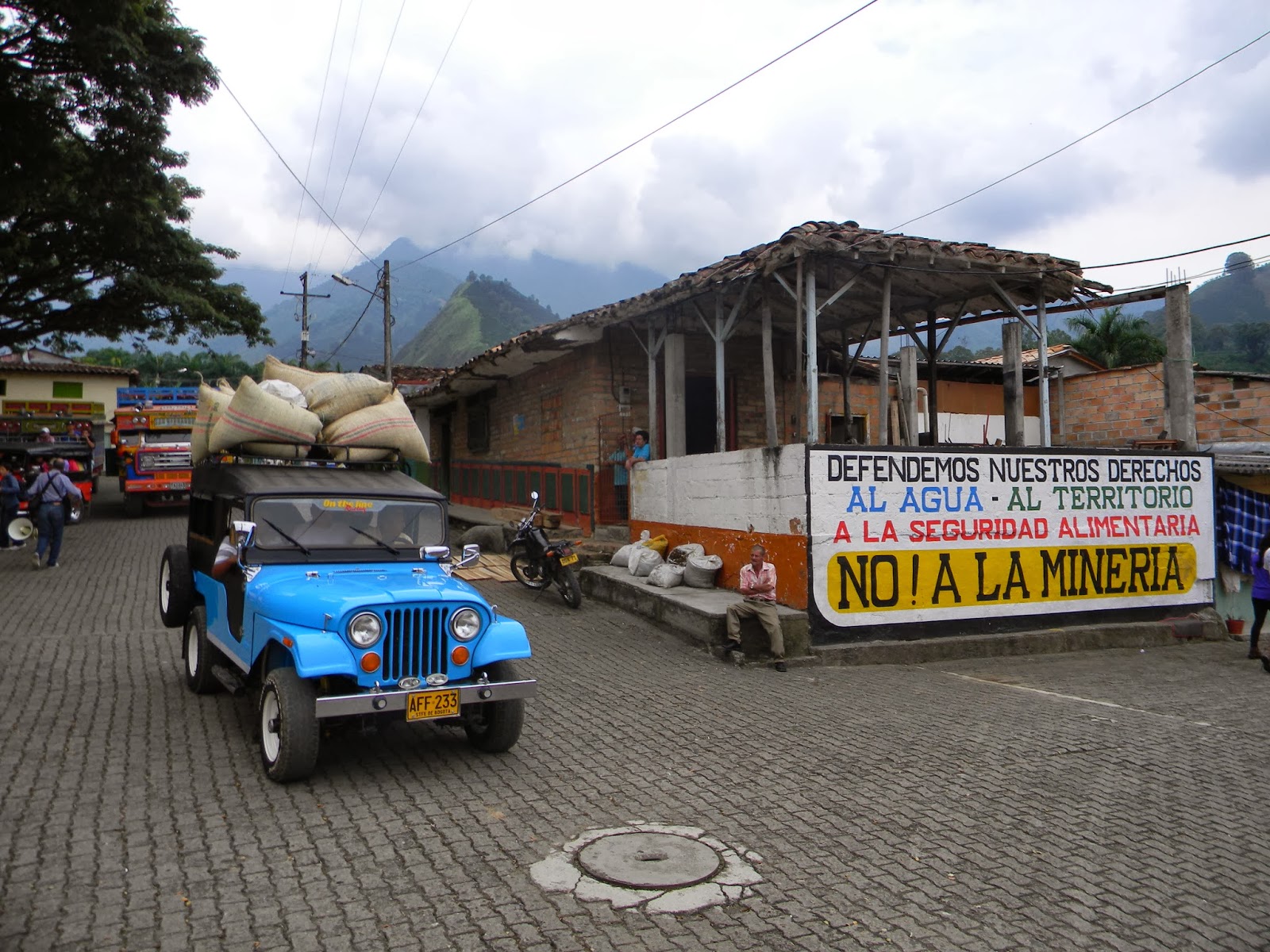
To end our time in Farallones, we accompanied the Environmental Working Group of Farallones and other local and regional social organizations in an “Open Town Hall Meeting in Defense of Cultural and Environmental Heritage: No to Mining” that took place February 22nd in the Educational Institute San José de Citará in Ciudad Bolívar. Around noon, residents from all the rural communities of Farallones and San Gregorio set out in 8 Jeep Willys and with 2 buses of the Indigenous Guard, from the central park of Farallones towards Ciudad Bolívar. Throughout the whole trip and upon arriving at the event everyone was energized and excited, and shouting out chants against mining and for life and water. Once we got into the auditorium, people started hanging up signs against mining on the walls, and we hung our Mesoamérica Resiste and Plan Colombia banners.
 
To open up the Town Hall meeting, the city councilors of Ciudad Bolívar, led by the Council President, tried to kill the space of the open forum with bureaucracy, imposing a protocol where the only people who could speak were people who had registered at least three days in advance.  We Bees asked everyone we could in the auditorium if they'd known about this rule beforehand, and everyone responded that they hadn't. A group of people from many professions made their way to the front, including lawyers, chemical engineers, professors, the previous mayor of the Andes municipality, representatives from Corantioquia, and others, giving good arguments for why Farallones de Citará should become a protected area, speaking out in support of ecological agriculture and outright rejecting the mining industry. Every time people from the audience clapped or tried to speak or ask questions, the Council president threatened to suspend the town hall meeting and bring in the police to remove those people, pathetically hiding behind a rule of “not being able to show a bias.” Although the open space of the town hall meeting was frustrated by bureaucracy and the interests of the councilors, without a doubt the people of Farallones, Ciudad Bolívar and many others in the southeast of Antioquia don't want mining, and do want coffee production, their mountains, forests, and water, and they are ready to defend their territory against the threat of mining.

After that meeting, our artist residency with Contraexpediciones came to an end, and next we will be working on creating the exhibit for the Museum of Antioquia, a combination of photographs of the projects we worked on in Farallones and some examples of the Beehive Collective's graphics campaigns. For now the Bees will continue pollinating in other places, in familiar communities and new places too, but above all we are very, very thankful for the community of Farallones and its surroundings for receiving us, and dreaming, sharing and creating with us. We look forward to the possibility of being able to return as soon as possible to continue using art to recreate territory. 


lunes, marzo 10, 2014

Contraexpediciones Antioquia: ¡Minería fuera de los Farallones de Citará!


Desde que iniciamos este proyecto llamado Polinizaciones en el año 2007, nosotras las abejitas del Colectivo de Diseño la Colmena que vivimos acá en el sur, en Abya Yala, hemos tenido el gran privilegio de compartir con varias comunidades en territorios tan bellos y majestuosos como los y las habitantes de esas zonas.  Con nuestra participación en el proyecto de Contraexpediciones organizado por el Museo de Antioquía tuvimos el privilegio de poder conocer, compartir, soñar y crear con otra comunidad y otro territorio que nos deja muy alegres y agradecidxs por esta oportunidad tan especial.  


Contraexpediciones, la tercera exposición que hace parte de la Plataforma Antioquias, articulará diversas miradas históricamente legitimadas y modelos de representación sobre mundo natural, con visiones artísticas contemporáneas y experiencias colectivas y comunitarias en diferentes territorios en relación a su entorno “natural” fundamentalmente en la región de Antioquia, con el objetivo de evidenciar y reflexionar acerca de tensiones entre grupos sociales, sus territorios y recursos. El ideal colonizador implícito en el término expediciones, como las ocurridas en Colombia en el siglo XIX, lleva el Museo plantear una serie de contraexpediciones que visibilicen las múltiples miradas a los territorios y la construcción colaborativa de conocimiento sobre estos. Como resultado de estas residencias se realizará una exposición en el Museo de Antioquia que dará cuenta los proyectos desarrollados en la región de manera simultánea con otros desarrollados en la ciudad de Medellín.

El Colectivo de Diseño la Colmena fuimos invitadxs a participar en una residencia artística como parte de este proyecto. Como grupo tenemos una política fuerte de romper el monopolio que las ciudades tienen sobre el arte y cultura; y en cambio proponemos llevarlo al campo, al monte, a las comunidades rurales y con esta propuesta de trabajo hicimos exactamente eso. La verdad, faltaban días para comenzar nuestra residencia artística y aún no habíamos ubicado una comunidad que nos pudiera recibir, en último momento fuimos nosotras las escogidas por los habitantes de San Bernardo de los Farallones en el Municipio de Ciudad Bolívar en el suroeste Antioqueño, mejor conocido como Farallones.

La verdad ninguna de nosotras habíamos escuchado de Ciudad Bolívar y mucho menos sabíamos de Farallones y su proceso de defensa territorial ante la amenaza de minería de oro y deforestación, que unos meses atrás había tenido apoyo de amigas hormigas y el Colombo Americano de Medellín. La bio-región de Los Farallones de Citará son unas montañas de la Cordillera Occidental de los Andes Colombianos  que forman parte del Cinturón Occidental Antioqueño.  Estas montañas, sus bosques de neblina y páramos forman parte del Andén del Pacífico y tiene una gran riqueza de biodiversidad, fuentes hídricas, metales y sobre todo oro. En el municipio de Ciudad Bolívar existe la amenaza de ciertas minas pequeñas, la mayoría ilegales según el Estado, pero hasta el momento no ha entrado ninguna empresa grande nacional o transnacional.

La Mesa Ambiental de Farallones lleva un proceso defensa territorial, educación y sensibilización con lxs habitantes de la región no solo sobre la amenaza de la minería, sino también en la importancia de no deforestar los bosques o contaminar los ríos.  La multitud de ríos y quebradas que bajan de los farallones sostiene esta comunidad agrícola, sobre todo cafetera, en todas sus labores. En la comunidad también existe un parque ecológico donde se encuentra una gran variedad de plantas, un charco para nadar, espacios de recreación y un vivero de plantas medicinales y árboles nativos para proyectos de reforestación. El territorio es habitado por muchos campesinos de diversos orígenes, entre ellos, una comunidad originaria del Pueblo Embera Chamí ubicados en el Resguardo Hermeregildo Chakiama. Además de humanos, este territorio es el hogar de una variedad de especies de Heliconias, arboles, frailejón, líquenes, musgos, la palma de cera, animales como guagua, armadillo, tigrillo, el oso de anteojos y una variedad de aves, incluyendo especies amenazadas como el gallito de roca y el loro oreji-amarillo ave endémica en Colombia. 

Al llegar el Instituto Educativo Rural (IER) Farallones, nos abrieron las puertas y acogieron a estas abejitas como si estuviéramos en nuestro propio panal. Allí el proyecto fue liderado por  estudiantes de octavo y noveno quienes coordinaron el proceso en el que otras personas de la comunidad también participaron. Esta fue nuestra tercera ocasión usando una adaptación de la metodología que utilizamos para crear nuestras campañas gráficas, los afiches, para pintar murales como un proceso colaborativo entre las abejas y la comunidad que nos acoge. Hace un año que inauguramos esta metodología con nuestro amigo Guache Arte Callejero y de nuevo tuvimos  el gusto de unir fuerzas con él para este proyecto.
  
El primer día presentamos el telón de Mesoamérica Resiste a lxs estudiantes de octavo y noveno del IER, también mostramos fotos y les contamos sobre los murales que pintamos en La Jagua, Huila y Retalteco, Petén, Guatemala. Los siguientes días, personas de la comunidad nos llevaron a lugares sagrados y especiales, pero también vimos las problemáticas de la región que está amenazando estos espacios. A poca distancia de la cascada conocida como “Cola de Caballo” estaba un socavón, una mina de oro. Aunque había un aviso de Corantioquia y la Gobernación de Antioquia declarando esa mina ilegal y cerrada; un cerro de escombros salía de la mina y llegaba a la orilla de la quebrada, las tuberías regadas por el río y las herramientas dentro de la mina fueron evidencia suficiente de que en esta mina se sigue trabajando. También por todas las montañas se veía cómo la frontera agropecuaria seguía avanzado, subiendo por la montaña talando bosque y dejando peladeros para sembrar monocultivos de café. Pocas fincas aún emplean técnicas de agricultura ecológica, sin embargo hay unas cuantas.

Uno de los recorridos fue a la cadena de cascadas y al túnel conocido como el Charco de los Patos, nos acompañaron más o menos unos 15 estudiantes del IER con quienes estudiamos la vegetación y geografía del territorio en el camino. Luego realizamos unos ejercicios de dibujar bocetos de los murales con los y las estudiantes usando frases como “el agua vale más que el oro”, “la vida vale más que el oro”, “aguas para la vida, no para la minería” para ayudarlxs a fluir sus ideas y pasarlas de la mente al papel. Después de la creación de los dibujos de manera individual se hizo otro ejercicio de creación de bocetos pero ya en grupos de 4-5 estudiantes.  Esa noche revisamos más de 45 borradores y acogiendo las temáticas más comunes y representativas, se crearon los bocetos de los dos murales que se pintaron en el pueblo.

Además de reconocer y rescatar memoria y conocimiento del territorio, otra parte importante del proceso de crear los murales consistió en que los y las estudiantes perdieran el miedo de soñar, a equivocarse, a crear y aprender. A demás de los estudiantes que desde el comienzo tenían toda la buena voluntad de colaborar, fue bonito ver como los y las jóvenes que temían un poco agarrar un pincel o brocha iban perdiendo el miedo durante el proceso y participaban en la creación de las imágenes. Los dos murales en el pueblo muestran no solamente la diversidad de plantas, animales y de territorio que todxs tenían que estudiar para representarlos adecuadamente allí, también muestran la diversidad de estilos artísticos, miradas y gustos de todas las personas que participaron.  Durante los días que se realizaron los murales, las vecinas de la cuadra donde estábamos pintando fueron increíblemente amables y acogedoras con nosotrxs dándonos jugos fríos para tomar bajo el rayo de sol y dejándonos guardar los materiales en sus casas.

Además de los dos murales en el pueblo se hicieron varias intervenciones artísticas, así como un tercer mural que fue pintado en el IER.  El mural fue idea de un estudiante Embera Chamí que conto la historia de cómo una gran serpiente creó los ríos con su cuerpo. El último día después de terminar ese mural tuvimos la oportunidad de visitar la comunidad del estudiante, el Resguardo Hermeregildo Chakiama y reunirnos con el gobernador y lxs profesores de la escuela del resguardo para compartir experiencias. Pudimos contarles qué era lo que hacíamos con lxs estudiantes y los murales y también mostrar y narrarles el telón grande de Mesoamérica Resiste, dejándoles afiches de la gráfica a lxs profesores para usar en sus salones. Todas las personas expresaron que les gustó mucho el trabajo y quedamos invitados para regresar a pintar murales en la comunidad y compartir las otras campañas graficas de la Colmena. 
 
Terminando nuestro tiempo en Farallones acompañamos a la Mesa Ambiental de Farallones y otras organizaciones sociales locales y regionales en la realización del “Cabildo Abierto en defensa del Patrimonio Ambiental y Cultural: No a la minería” que ocurrió sábado 22 de febrero en el Instituto Educativo San José de Citará en Ciudad Bolívar.  Al medio día, habitantes de todas las veredas de Farallones y San Gregorio salieron en 8 chiveros (Jeep Willys) y en 2 chivas de Guardia Indígena, del parque central de Farallones hacía Ciudad Bolívar. Por todo el camino y llegando al evento las personas iban animadas, alegres y cantando consignas en contra la minería y en pro de la vida y el agua. Entrando al auditorio distintas personas colgaron pancartas en las paredes en contra la minería y nosotras colgamos los telones de Mesoamérica Resiste y Plan Colombia.

Al comenzar el Cabildo los concejales de Ciudad Bolívar liderados por el presidente del Consejo, intentaron matar el espacio del cabildo abierto por medio de la burocracia, imponiendo un protocolo donde las únicas personas que podían hablar en el cabildo, fueron personas que se habían inscrito con más de tres días de anticipación. Las abejitas preguntamos a todas las personas que pudimos en el auditorio si sabían de esa norma antes y todxs respondieron que noPasaron al frente una cantidad de personas de distintos conocimientos incluyendo abogados, ingenieros químicos, profesores, el anterior alcalde del municipio de Andes,  representantes de Corantioquia y otrxs todos dando buenos argumentos del porque los Farallones de Citará se deben volver un área protegida, respaldar la agricultura ecológica y rotundamente rechazar la minería.  Cada vez que personas en la audiencia aplaudían o intentaban hablar o preguntar, el presidente del consejo amenazaba con suspender el cabildo abierto o traer la policía para sacar a esas personas, patéticamente escudándose en una norma de “no poder mostrar parcialidad”. Aunque el espacio del cabildo abierto quedó frustrado por la burocracia e intereses de los concejales, no cabe duda de que la población de Farallones, Ciudad Bolívar y muchas personas en el suroeste Antioqueño no quieren a la minería y sí quieren café, quieren sus montañas con bosques y quieren el agua, y están dispuestos de defender su territorio ante esa amenaza.

Después del Cabildo abierto cerramos nuestra residencia artística como parte de Contraexpediciones y ahora nos falta crear la exposición que se va mostrar en el Museo de Antioquia, una combinación de fotografías del proceso realizado con la comunidad de Farallones  y unos ejemplares de las campañas graficas del Colectivo la Colmena.  Por ahora las abejas seguimos polinizando en otros lados, comunidades conocidas y lugares nuevos también, pero sobretodo quedamos muy, muy agradecidas con toda la comunidad de Farallones y sus alrededores por recibirnos, soñar, compartir y crear con nosotras.  Nos anticipamos a la gran posibilidad de poder volver lo más pronto posible para seguir recreando el territorio.


The Quimbo Hydroelectric Project Moves Ahead without Complying with its Environmental License

Original Source: Upside Down World

Months after displacements, the Association of People Affected by the El Quimbo Hydroelectric Project (Asoquimbo) still demands that the El Quimbo hydroelectric project comply with its environmental license.


Following the evictions that began on September 24 last year on several farms near La Jagua, Garzon and Gigante, all located in the area of impact of the Quimbo Hydroelectric Project, the affected communities continue to mobilize and denounce the construction of the dam that is currently being carried out on the Magdalena River.

Throughout the closing months of last year, Miller Dussan, a professor at the Sur Colombiana University, has been giving a series of lectures in different mid-Atlantic US cities, such as Boston, New York and Washington D.C., where he has denounced the abuses and repression of victims in Huila at the hands of both the State and those in charge of the Quimbo Hydroelectric Project. In a conversation with Brent Blackwelder from Friends of the Earth, the National Wild and Scenic Rivers System, a systems of protected rivers created in the U.S. in 1973, was brought up and how to create a similar international systems was discussed. During the same time, Isabel Cristina Zuleta, a representative of Ríos Vivos, roundly denounced hydroelectric projects in Colombia before the Inter-American Court of Human Rights (IACHR) and requested interim measures and the suspension of El Quimbo and other dams which are presently under construction such as Hidroituango (Antioquia) and Hidrosogamoso (Santander).


In October, Asoquimbo participated in two international gatherings that brought together people from a variety of communities and countries impacted by dams and other mining and energy projects. In the community of Retalteco in Peten-Guatemala, members of Ríos Vivos Colombia; impacted by the Quimbo Hydroelectric Project, Hidrosogamoso and Hidroituango participated in the 5th Gathering of the Latin American Network of Against Dams (REDLAR) along with people from Mexico and Central and South America. Zoila Ninco, member of Asoquimbo, and Ríos Vivos from La Jagua, Huila explained that “being able to come to Guatemala and see how the government keeps communities who oppose dams completely abandoned and that the communities remain firm and united against such desolation is an example and inspiration for what we need to be against the Quimbo.” 

At the same time as the REDLAR gathering, Asoquimbo and Ríos Vivos organized in Neiva and La Jagua the “International Gathering on the Extractive, Energy-Mining Model for the Defence of the Territories.” Present were representatives of the Stop Enel Campaign (centered in Italy) and the Maya Ixil People who have been impacted by the Palo Viejo dam in Guatemala. From Colombia there was participation from the National Association of Peasant Reserve Areas (Anzorc) and the Association of Indigenous Councils of Northern Cauca (ACIN). The meeting culminated in a march that began in La Jagua and ended with a rally in the central park of Garzón. 

An element of the environmental license that the company responsible for the El Quimbo Hydroelectric Project, Emgesa-Endesa -Enel has consistently ignored is the care of the archaeological and cultural heritage of the affected area. Along the banks of the Yaguilga river in the municipality of El Agrado is the quiet community of San José de Belén. The church of San José de Belén has been recognized as a historical heritage building and is considered the oldest structure in the municipality being that San Jose was founded before El Agrado. According to the environmental license, the company is obliged to relocate the community as a whole together with the chapel in its new location; however, instead of fulfilling this obligation the company is trying to convince community members (with cash bribes) to not pressure for the company to perform this collective relocation.


The territory that today is threatened by the El Quimbo Hydroelectric Project is the territory of the great original peoples such as the Tama (the Payoguaje, according to some), the Nasa, the Andaki and the Yalcón. The whole territory is full of evidence of the presence of the ancestors of local inhabitants; milling stones, ceramic vases, nose rings, and tombs (known as Guacas) which should be left in peace.

By means of the environmental license, Emgesa-Endesa- Enel and the Colombian Institute of Anthropology and History (ICANH) have used the Preventive Archaeology Program as a tool in removing cultural property from the territory, also part of the license is that all objects and their image are intellectual property of the company and if not for the good will of some archeologists, local residents would have no access to cultural remains, some dating as far back as 100-300 BC. According to the ICANH, the company must create a museum with these objects in one of the communities in the affected area and so far no one knows where the museum will be located, when it will be ready, who will manage it or if the descendants of the peoples whose items are on display will be charged admission.

As the Quimbo Project progresses, so do all the other hydroelectric projects which have been planned for Huila. Although currently pending, Emgesa-Endesa-Enel is awaiting approval by the National Authority of Environmental Licenses (ANLA) to start the Oporapa Hydroelectric Project. It would be a 280 MW hydroelectric plant, which would affect the municipalities of Isnos, Saladoblanco, Oporapa, Tarquinia, Elias and Pitalito, as well as the Rumiyaco Indigenous Reservation of the Yanacona People. The Oporapa Hydroelectric Project, as well as the Isnos, Guarapas, Chillurco, Oporapa, Pericongo Paez, Aranzazu, La Plata and Paicol dams which are also planned for the upper basin of the Magdalena River as part of the strategy of the national government to privatize the river. Known as the “Master Plan for Development of the Magdalena River”, is being carried out by Cormagdalena in association with the Chinese government owned HydroChina with an operating budget budge of U$6,000,000. 

For well over a year, when Emgesa - Endesa- Enel buys a property in the communities of La Escalereta, el Balseadero or San José de Belén, it proceeds to demolish any structures immediately without any thought of the socio-psychological impact on the people who are still living in these communities. In addition to these communities, the company still needs to buy about 150 farms but it has not yet managed to do so. Antonio Sarmiento, the Quimbo director, says that the owners “refuse to sell or ask for too high a price.”

  
In January 2014, the majority of these homeowners received expropriation orders from the State. Asoquimbo, together with the Tierra Digna Legal Organization, is currently working with the owners and people from other sectors whose rights have been ignored by the company and the State. Joaquin Avila Ramos, one of the brothers belonging to a family from La Jagua who received an expropriation order, said that “these lands have given us the sustenance of life. We are a family of 8 siblings and our mother, we are all independents and the company wants to settle with us all together for an amount of U$8,500.oo each! This is not the real value for our 6 hectares which are surrounded by Magdalena and Suaza Rivers.”

In early February 2014, Carlos Cardozo, a journalist in the region, documented the extensive deforestation carried out by Endesa- Enel - Emgesa on the banks of the national road between Garzón and Rioloro. As a result of cutting down of several hectares of forest, local inhabitants have seen the dead bodies of animals like ocelots, deer, fox, coati, opossum and a variety of snakes that have all been killed in their attempt to escape the destruction. According to Cardozo, the inhabitants of the region, “have never before seen these animals in this sector before.


In the final weeks of February the Constitutional Court of Colombia ordered that Emgesa-Endesa-Enel re-open the census for the impacted population citing a long list of inconsistencies in implementation of the dam´s construction. Currently Quimbo management says that the project is approximately 55% completed and distracting many from varied requirements part of the project’s environmental license that remain unfulfilled. During this time of territorial defence and forced displacement executed by the State in order to maintain the multi-national company´s “investor confidence”, it has become apparent to inhabitants impacted by the Quimbo hydroelectric project that the State must be made to fulfil its duties towards the population, and that this will only happen through direct action. In the coming months diverse and directed nonviolent protests and legal action will take place to demand that the State forces the company to fulfil its duties with regard to the affected population.

lunes, febrero 24, 2014

Intermundos :: Cartografias al acecho :: 1 de marzo sector barbacoas, centro de Medellin. Activación.


Estaremos en una esquina del sector de barbacoas en el centro de Medellin que guarda el pasado y presente de esta ciudad.
Pinta >> Pachamama Aka J.f velez.
Concierto >> Desadaptadoz >> Despues de las 6pm
Poryeccion / mapeo >> Melaganodeojo