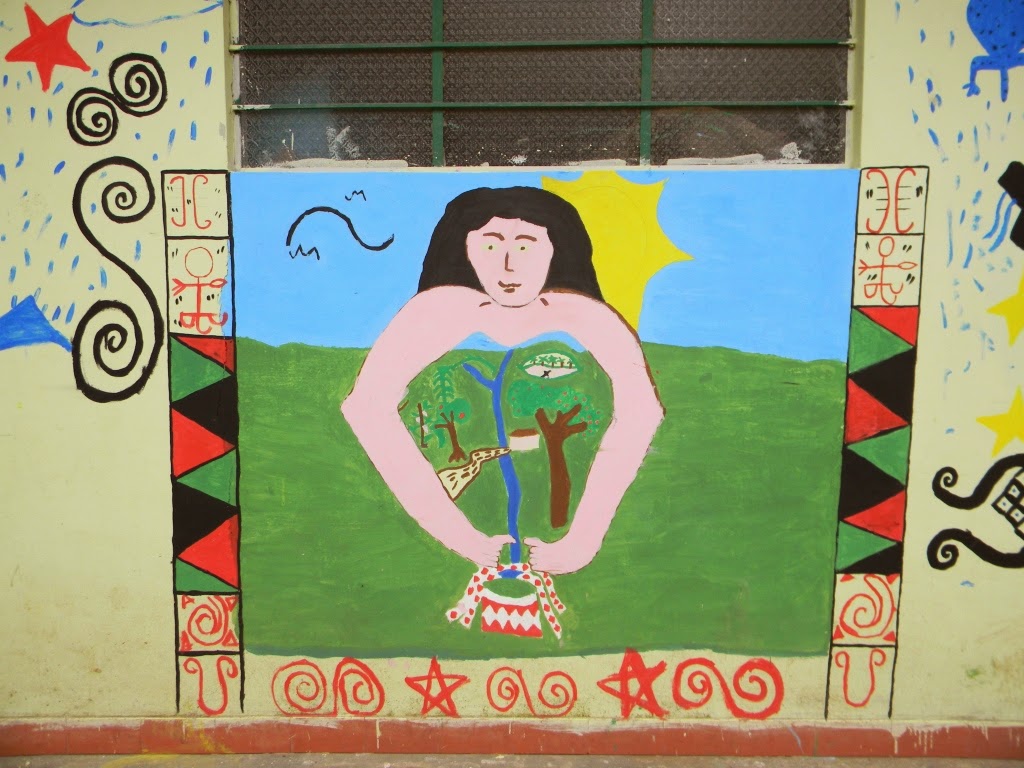
Photos by Libertatia
 By means of our exercise
of pollinations, we the bees search to build with processes of territorial
defense. Most of these regions where we seek to develop this labor are rural,
though none the less we recognize that in the cities, in urban center,
especially in the marginal, outlying and excluded neighborhoods there are also
processes of territorial defense. These processes are not only about issues
that are typically seen as urban struggles such as access to social services,
better working condition or against police brutality, there are also land
struggles to defend the territory from the practices of extractivism in order
to have a healthy and livable urban environment.
By means of our exercise
of pollinations, we the bees search to build with processes of territorial
defense. Most of these regions where we seek to develop this labor are rural,
though none the less we recognize that in the cities, in urban center,
especially in the marginal, outlying and excluded neighborhoods there are also
processes of territorial defense. These processes are not only about issues
that are typically seen as urban struggles such as access to social services,
better working condition or against police brutality, there are also land
struggles to defend the territory from the practices of extractivism in order
to have a healthy and livable urban environment.
An urban
territory that we frequented since the beginning of Polinizaciones is the
locality of Ciudad Bolivar, in the south of Bogotá. This locality is born of
the displaced peasants that fled their rural homes d uring “La Violencia” in the
middle of last century arriving to the capitol. Today Ciudad Bolivar has over
one million inhabitants and is mostly known for negative aspects such as a
place of violence, poverty and abandon; though it is also a territory where
communities, with dignity and valor, have organized and struggles in hopes of
defending their territory.
uring “La Violencia” in the
middle of last century arriving to the capitol. Today Ciudad Bolivar has over
one million inhabitants and is mostly known for negative aspects such as a
place of violence, poverty and abandon; though it is also a territory where
communities, with dignity and valor, have organized and struggles in hopes of
defending their territory.
 uring “La Violencia” in the
middle of last century arriving to the capitol. Today Ciudad Bolivar has over
one million inhabitants and is mostly known for negative aspects such as a
place of violence, poverty and abandon; though it is also a territory where
communities, with dignity and valor, have organized and struggles in hopes of
defending their territory.
uring “La Violencia” in the
middle of last century arriving to the capitol. Today Ciudad Bolivar has over
one million inhabitants and is mostly known for negative aspects such as a
place of violence, poverty and abandon; though it is also a territory where
communities, with dignity and valor, have organized and struggles in hopes of
defending their territory.
During this
visit to Ciudad Bolivar we shared with a beautiful process that with much
dignity is an autonomous, self-reliant, do-it-yourself space known as: the
Libertatia Social Center. Libertatia has existed as a physical space, a house,
for about three and a half years, where different collectives meet and build
together to change the living conditions of the inhabitants of Ciudad Bolívar from
the different life styles and ways that affect them and affect everyone; such
as science, technology, education, reading & writing, ecology and fighting
all forms of oppression based on gender, ethnicity, race, sexuality and much
more. 

One afternoon in
front of the Libertatia house with members and the neighbors we were able to
complete a collective analysis of the Mesoamérica Resiste graphic
campaign. The methodology we used was to
separate the participants in different groups and start to analyze and
interpret the images of the graphic, using the banner as a window into the
world that we have been forced to live in. That way without any instruction,
the neighbors and members of the Social Center started to imagine and decipher
the experiences that are found within each scene. Present there were many
people; children, youth, adults, elders that were all very interested and questioned;
what is this world we see in the graphic?

The
participants divided into different groups and each group started to analyze
the scenes assigned to them to later present it to the other groups of
participants. The intergenerational dialogue that took place was very succinct
and interesting, it was a collective construction amongst the children, youth,
adults, elders and everyone debated with much interest in the construction and
explication behind each scene.
This territory
unfortunately is not foreign to mining and extractivism, it is important to
mention that days before the workshop, a permanent blockade camp for the defense of our territories was lifted, after 32 days in the Potosi
neighborhood, within Ciudad Bolivar.  The defense camp blocked the entrance of
the quarry, where neighbors, children, youth, adults and elders united forces
in resistance effectively paralyzing the operations of the Canteras Unidas La Esmeralda quarry that has been functioning for many years as an illegal operation
of open pit mining for the extraction of construction materials within the
immediate vicinity of local communities. The Environmental Roundtable “Don´t take the rock out of the Mountain”, made of various local groups including the
Libertatia Social Center, led a process that effectively shut down the mines.
Unfortunately as a result of these efforts various members of the Environmental
Roundtable have been threatened by the right wing paramilitary group, the Black
Eagles (Águilas Negras).
The defense camp blocked the entrance of
the quarry, where neighbors, children, youth, adults and elders united forces
in resistance effectively paralyzing the operations of the Canteras Unidas La Esmeralda quarry that has been functioning for many years as an illegal operation
of open pit mining for the extraction of construction materials within the
immediate vicinity of local communities. The Environmental Roundtable “Don´t take the rock out of the Mountain”, made of various local groups including the
Libertatia Social Center, led a process that effectively shut down the mines.
Unfortunately as a result of these efforts various members of the Environmental
Roundtable have been threatened by the right wing paramilitary group, the Black
Eagles (Águilas Negras). 
 The defense camp blocked the entrance of
the quarry, where neighbors, children, youth, adults and elders united forces
in resistance effectively paralyzing the operations of the Canteras Unidas La Esmeralda quarry that has been functioning for many years as an illegal operation
of open pit mining for the extraction of construction materials within the
immediate vicinity of local communities. The Environmental Roundtable “Don´t take the rock out of the Mountain”, made of various local groups including the
Libertatia Social Center, led a process that effectively shut down the mines.
Unfortunately as a result of these efforts various members of the Environmental
Roundtable have been threatened by the right wing paramilitary group, the Black
Eagles (Águilas Negras).
The defense camp blocked the entrance of
the quarry, where neighbors, children, youth, adults and elders united forces
in resistance effectively paralyzing the operations of the Canteras Unidas La Esmeralda quarry that has been functioning for many years as an illegal operation
of open pit mining for the extraction of construction materials within the
immediate vicinity of local communities. The Environmental Roundtable “Don´t take the rock out of the Mountain”, made of various local groups including the
Libertatia Social Center, led a process that effectively shut down the mines.
Unfortunately as a result of these efforts various members of the Environmental
Roundtable have been threatened by the right wing paramilitary group, the Black
Eagles (Águilas Negras). 
This Base Camp
for the defense of the territory enabled the movement to create environmental
consciousness not only in the neighborhood of Potosi, but also other
neighborhoods and helped locals reflect and ask themselves if they wanted
mining in their neighborhood. To think if it is the extractive project that
negatively impacted their health, the health of their children and loved ones.
The mining is what was responsible for the community´s inhabitants’ respiratory
problems.
That a process
such as this existed in this neighborhood is what helped open the doors for Polinizaciones
to visit, nurture and pollinate other experiences that helped strengthen this
struggle. Thanks to this the people in attendance started to ask themselves
questions, in an attempt to describe what was going on in the images they
looked at. Finally, sometime after the collective analysis, the folks present
started to share what they were able to decipher and interpret from the images
to the other folks participating. 

After this
collective creation, and after sharing some bread and drinking hot agua de panela, we started to explain
what each image met one by one, highlighting that the local inhabitants and
members of the Social Center were correct in the majority of their interpretations.
It was very interesting to see how folks were so doubtful about some symbols
that were present, they did not understand some symbols and tried to give shape
and figure out in their head what they could possible mean. The workshop ended
with a special thanks to everyone who came out to participate and the
Libertatia Social Center that received us, hosted the activity, and was
interested the entire time of the exercise and presentation. 

Many years past
since the last time we shared our graphic campaigns in the south of Bogotá,
more specifically in Ciudad Bolivar. Now with this first cross pollination
after knowing each other for some time, the bees and the flying whale (the
symbol of the Libertatia Social Center) hope to find each other sooner than
later, to help generate movement and processes that are able to strengthen
territories for life, for and by liberated peoples.