
 In
2008, when Polinizaciones first toured through the Department of Cauca,
we got to know a community that we were able to visit again this time
around, the Misak People of
the Indigenous Reserve of Wuampia. It was wonderful to be able to
return to Misak territory, see a few old friends, and make new friends; a
friend that is involved in Misak environmental and land projects helped
coordinate our visit as part of this tour. Besides returning to spaces
we'd been in years before to present the Plan Colombia banner, this time to present Mesoamérica
Resiste, we were also able to visit the Kizgó community for the first
time, in the same municipality of Silvia. During this stay we stayed in
the traditional medicine center in the Misak Reserve of Wuampia,
surrounded by gardens of many kinds of healing, curative plants. Much of
the land of the reserve is liberated land, that was recovered
from large landowners in the 1970s by those who are elders in the
community now. In this visit, like those before, we had the opportunity
to share our work in many spaces, with young girls and boys, older
youth, adults, and elders.

In 2011 the council of the Indigenous Reserve of Wuampia and the Misak People, became concerned about issues dealing with environmental
and land degradation and the politics of the state. More specifically the wants to dismantle
the traditional authorities on the national level, claiming that they
are not environmental authorities in their own territories; not
recognizing the ancestral originality of the Misak People, or the historical processes of struggle for their land, and also not
recognizing national and international agreements and rights of
indigenous peoples regarding their territoriality and originality.
Coming from the Elders words and the ancestral duty of the Misak in
recent years there has been a process of organization and
development of strategies for the protection and conservation of the
spaces of Misak life, coming from their own vision of natural balance,
with environmental processes that seek to put the management of natural
resources into the communities' own hands, with the goal of the Misak
Peole having control over their own environment, based in fundamental
Misak principles of reciprocity and integrality, for the permanent survival
of the Misak People. The objective of this process is to reclaim their
own way of thinking, to revitalize the harmony and balance of the land
that allowed their ancestors to survive, through nurturing and
strengthening Misak territory. 
The
first day was a spectacular morning with fresh air coming down from the
high mountain moors and the sun shining strong, so we decided to
do our workshop in the soccer field of the Tranal Educational
Institute of the Wuampia Reserve. All of the students participated and
each group presented part of the graphics to the other groups. In the
workshop we learned that since we last visited there have been problems
with people coming in to colonize this area, pushing gold mining and
bringing in drainage equipment that has caused great environmental,
cultural, and social conflicts.  There are currently 31 mining proposals
for the municipality of Silvia given by the government´s geological entity, INGEOMINAS, two that are within Misak territory, taking up 650 hectares of the high mountain moors of Mama Dominga, the water shed of the Junambu creek, and in the Peñon Peak, all sacred sites of our territory.
There are currently 31 mining proposals
for the municipality of Silvia given by the government´s geological entity, INGEOMINAS, two that are within Misak territory, taking up 650 hectares of the high mountain moors of Mama Dominga, the water shed of the Junambu creek, and in the Peñon Peak, all sacred sites of our territory.
Mining
brings many problems; it contaminates water, which is life; dries up
water and the mountain moors; destroys sacred sites that are part of
our territory; brings in people with weapons and
transnational companies. Mining in the Wuampia Reserve is prohibited by
traditional authorities; as well as any intervention by extractive
industries like transnationals and private companies interested in
making a profit off of the environment. 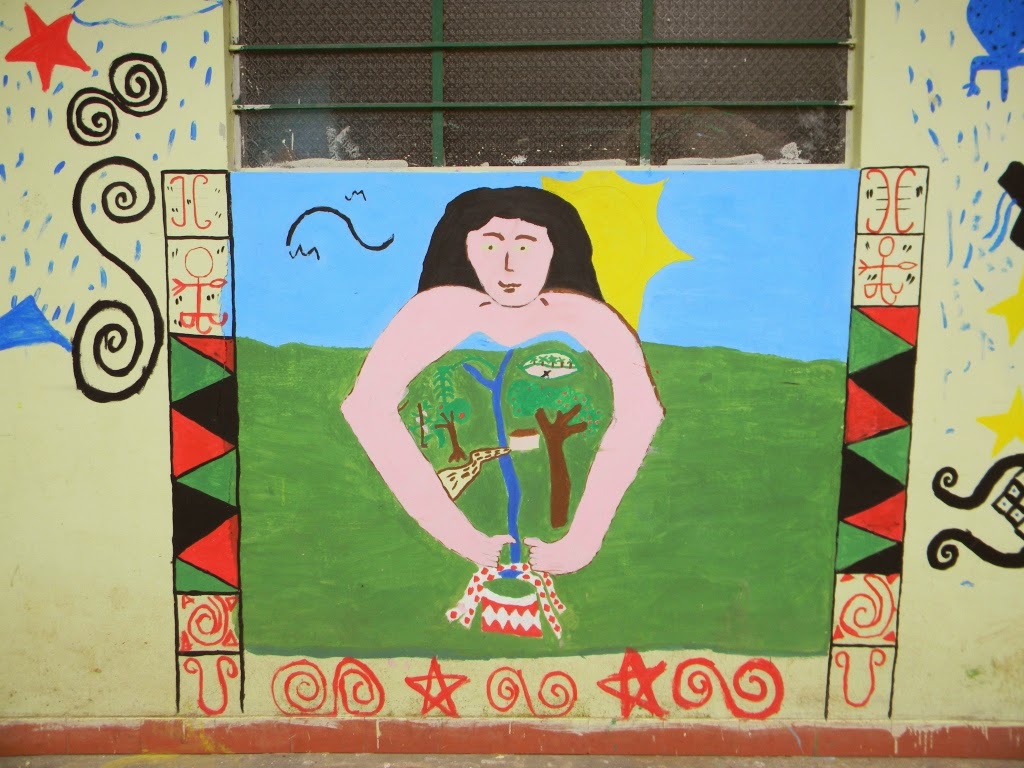 A previous Governor of the Misak
People, Tata Misael Aranda, explained in 2012, "The practice of mining
is like the cultivation of opium; at first it brings in money and
happiness, but in the end it only leaves behind poverty and social
problems, for that reason we say no to both small and large scale
mining.
A previous Governor of the Misak
People, Tata Misael Aranda, explained in 2012, "The practice of mining
is like the cultivation of opium; at first it brings in money and
happiness, but in the end it only leaves behind poverty and social
problems, for that reason we say no to both small and large scale
mining.
In the afternoon of that same day
we were able to do a storytelling of the Mesoamérica Resiste graphic
with students from the Namuy Misak Educational Center (in El Salado) of
the Kizgó Reserve, with some teachers joining in, as well as our
pollinator friends from the Colectivo Libre Colibrí; in
this area of El Salado there are also mining projects affecting the
river, and they told us that some youth from their own community are
involved in the mining without looking at the consequences that it
brings (easy money, but destruction of ecosystems and water
contamination), so this space to reflect together, using the Mesoamérica
Resiste banners, is one of many important spaces needed to rethink this
model of development and look for community alternatives. Coming to
visit the Kizgó Reserve was made possible by our hummingbird friends
from Colectivo Colibrí who participated in the first Beehive tour we did
here in 2008.
so this space to reflect together, using the Mesoamérica
Resiste banners, is one of many important spaces needed to rethink this
model of development and look for community alternatives. Coming to
visit the Kizgó Reserve was made possible by our hummingbird friends
from Colectivo Colibrí who participated in the first Beehive tour we did
here in 2008.
The
second day we returned to the same auditorium of the Guambiano
Agricultural Education Institute in the Wuampia Reserve where students
from many different classes participated in collectively studying and
analyzing the scenes in the graphics, and taking turns explaining and
sharing about what
they saw with the whole group.  In this workshop we heard that the
armadillo, which in the graphic represents an elder sitting with youth
around a fire in the community celebration scene, is a sacred animal for
the Misak People and represents working the land, and its shell
represents weaving (the warp and the weft). That afternoon we returned
to the Kizgó Reserve, this time to the Tengo Educational Center, where
we met up with the Colibrí Collective who again helped us tell the
stories of Mesoamérica Resiste and relate them to what is happening in
this region. We talked with the youth about the importance of water, in
the Kizgó Reserve are the headwaters of various rivers that flow to and
cool down many different farming and indigenous territories (like the
urban center of Silvia, the farming zone of Usenda and the municipality
of Caldono-Río Ovejas).
 One of the threats is the implementation of the
Departmental Water Law, already approved by the Mayor's Office of
Silvia, that some communities don't recognize, and it is still unknown what its reach will be in terms of privatizing natural springs, rivers,
and ravines in this area.
In this workshop we heard that the
armadillo, which in the graphic represents an elder sitting with youth
around a fire in the community celebration scene, is a sacred animal for
the Misak People and represents working the land, and its shell
represents weaving (the warp and the weft). That afternoon we returned
to the Kizgó Reserve, this time to the Tengo Educational Center, where
we met up with the Colibrí Collective who again helped us tell the
stories of Mesoamérica Resiste and relate them to what is happening in
this region. We talked with the youth about the importance of water, in
the Kizgó Reserve are the headwaters of various rivers that flow to and
cool down many different farming and indigenous territories (like the
urban center of Silvia, the farming zone of Usenda and the municipality
of Caldono-Río Ovejas). One of the threats is the implementation of the
Departmental Water Law, already approved by the Mayor's Office of
Silvia, that some communities don't recognize, and it is still unknown what its reach will be in terms of privatizing natural springs, rivers,
and ravines in this area.
For
our last day of workshops we were able to return to the place where we
did our first Plan Colombia presentation in Guambia, a place as special
as it is beautiful, in the house of "Tampal Kauri." This time it was a
school day for Misak University, an initiative of the Misak People to
create its own educational space after high school, with its own values,
perspectives and realities. It was without a doubt the largest and most
participatory workshop we've done on this tour, with more than 5 very
full hours of interactive storytelling and collective analysis, group
presentations, and a final summary of all their work, with more than 100
people participating.  People spoke up with a lot of enthusiasm, most of
them were bilingual in Spanish and in their own language, Nam Rik, and
participated in both languages, and they spoke about local issues
inspired by the scenes in the banner, like the threat of genetically
modified crops and the loss of their traditional clothing, and also
about the importance of the fireplace, that is at the center
of the university as well as at the center of their homes. They
congratulated us for the work of the Bees, and we left Mesoamérica
Resiste posters at Misak University like we do with all educational
institutions and teachers, collectives, and places where we do
workshops. After the workshop, like we did on our last visit, we did an
interview on Namuy Wam,
the indigenous community radio station of the Wuampia Reserve, where we
talked about our work and also issues related to megaprojects,
indigenous communities, and the environment in our entire hemisphere.

People spoke up with a lot of enthusiasm, most of
them were bilingual in Spanish and in their own language, Nam Rik, and
participated in both languages, and they spoke about local issues
inspired by the scenes in the banner, like the threat of genetically
modified crops and the loss of their traditional clothing, and also
about the importance of the fireplace, that is at the center
of the university as well as at the center of their homes. They
congratulated us for the work of the Bees, and we left Mesoamérica
Resiste posters at Misak University like we do with all educational
institutions and teachers, collectives, and places where we do
workshops. After the workshop, like we did on our last visit, we did an
interview on Namuy Wam,
the indigenous community radio station of the Wuampia Reserve, where we
talked about our work and also issues related to megaprojects,
indigenous communities, and the environment in our entire hemisphere.
Like
all of our visits to see our friends from the Misak community, this
visit was so lovely and welcoming that we hope we can return to Wuampia
and the surrounding areas of Silvia soon, to keep walking together with
the Misak People. As much as we are able to, we will continue to
accompany them and support educational processes through our
illustrations and other artistic expressions that highlight the
importance of land and autonomy. To be able to return here after so much
time reassures us that our buzzing around continues to be welcome, and
that there is still a long way to go and much work to do.


