Original Source: A la Orilla del Río
Photography: Diana Calderón Montes
Translation: Katy Clark
 The bees of the Beehive Design Collective
mark almost three years since we were in the Amazonian foothills territory of
Florencia (Caquetá) for the launch of ¡Mesoamérica Resiste! Thanks to an
invitation and collaboration on the part of A la Orilla del Río [At the River
Bank], the virtual center of thought in the Colombian Amazon region, with Movimiento
Ríos Vivos [the Living Rivers Movement], we were able to return to Florencia,
go to Morelia for the first time and make plans to return later this year to
continue our pollinations throughout the territory of Caquetá. On this
occasion, just as the first time, we were primarily in Florencia, where we held
workshops in different spaces and also were able to meet with processes of
environmental organizations, such as that of the Mesa Departamental para la
Defensa del Agua y el Territorio de Caquetá – MEDDAT [Departmental Table for
the Defense of Water and Territory in Caquetá].
The bees of the Beehive Design Collective
mark almost three years since we were in the Amazonian foothills territory of
Florencia (Caquetá) for the launch of ¡Mesoamérica Resiste! Thanks to an
invitation and collaboration on the part of A la Orilla del Río [At the River
Bank], the virtual center of thought in the Colombian Amazon region, with Movimiento
Ríos Vivos [the Living Rivers Movement], we were able to return to Florencia,
go to Morelia for the first time and make plans to return later this year to
continue our pollinations throughout the territory of Caquetá. On this
occasion, just as the first time, we were primarily in Florencia, where we held
workshops in different spaces and also were able to meet with processes of
environmental organizations, such as that of the Mesa Departamental para la
Defensa del Agua y el Territorio de Caquetá – MEDDAT [Departmental Table for
the Defense of Water and Territory in Caquetá]. MEDDAT is a meeting and coordinating space
of different civil society organizations for the defense of Amazonian territory
from extractive processes – primarily the extraction of oil. Currently Caquetá
is divided into 21 oil blocks that encompass the territories of every
municipality and belong to businesses such as Emerald Energy, Canacol, Hupecol,
Ecopetrol and the Agencia Nacional de Hidrocarburos [National Agency of Hydrocarbons],
all of which have been met with resistance throughout the entire territory.
MEDDAT is a meeting and coordinating space
of different civil society organizations for the defense of Amazonian territory
from extractive processes – primarily the extraction of oil. Currently Caquetá
is divided into 21 oil blocks that encompass the territories of every
municipality and belong to businesses such as Emerald Energy, Canacol, Hupecol,
Ecopetrol and the Agencia Nacional de Hidrocarburos [National Agency of Hydrocarbons],
all of which have been met with resistance throughout the entire territory. One of the strongest and most emblematic
processes in the region is that of the peasant farmer communities of Valparaíso
that have risen up against the incursion of the Chinese oil company Emerald
Energy. For a multitude of reasons, the community is against the extraction of
oil in their territory and has positioned themselves in opposition to the
project in multiple scenarios. They have continually been excluded from the decision
making process. On May 4th, 2015 the community decided to hold a peaceful
protest and establish an encampment on the bridge over the La Cacho creek,
impeding the pass of Emerald Energy’s heavy machinery. On June 30th,
the ESMAD [Riot polie] arrived to the protest site and, for the time being
evicted the encampment, leaving three wounded. So far the community has not
received an answer about who ordered the eviction and the use of force. Since
then the oil company has moved in and established itself.
One of the strongest and most emblematic
processes in the region is that of the peasant farmer communities of Valparaíso
that have risen up against the incursion of the Chinese oil company Emerald
Energy. For a multitude of reasons, the community is against the extraction of
oil in their territory and has positioned themselves in opposition to the
project in multiple scenarios. They have continually been excluded from the decision
making process. On May 4th, 2015 the community decided to hold a peaceful
protest and establish an encampment on the bridge over the La Cacho creek,
impeding the pass of Emerald Energy’s heavy machinery. On June 30th,
the ESMAD [Riot polie] arrived to the protest site and, for the time being
evicted the encampment, leaving three wounded. So far the community has not
received an answer about who ordered the eviction and the use of force. Since
then the oil company has moved in and established itself.  Like the first time, the places where we
were most able to share the work were the Instituto Educativo Jean Piaget (Jean
Piaget Educational Institute) and the Universidad de la Amazonia [University of
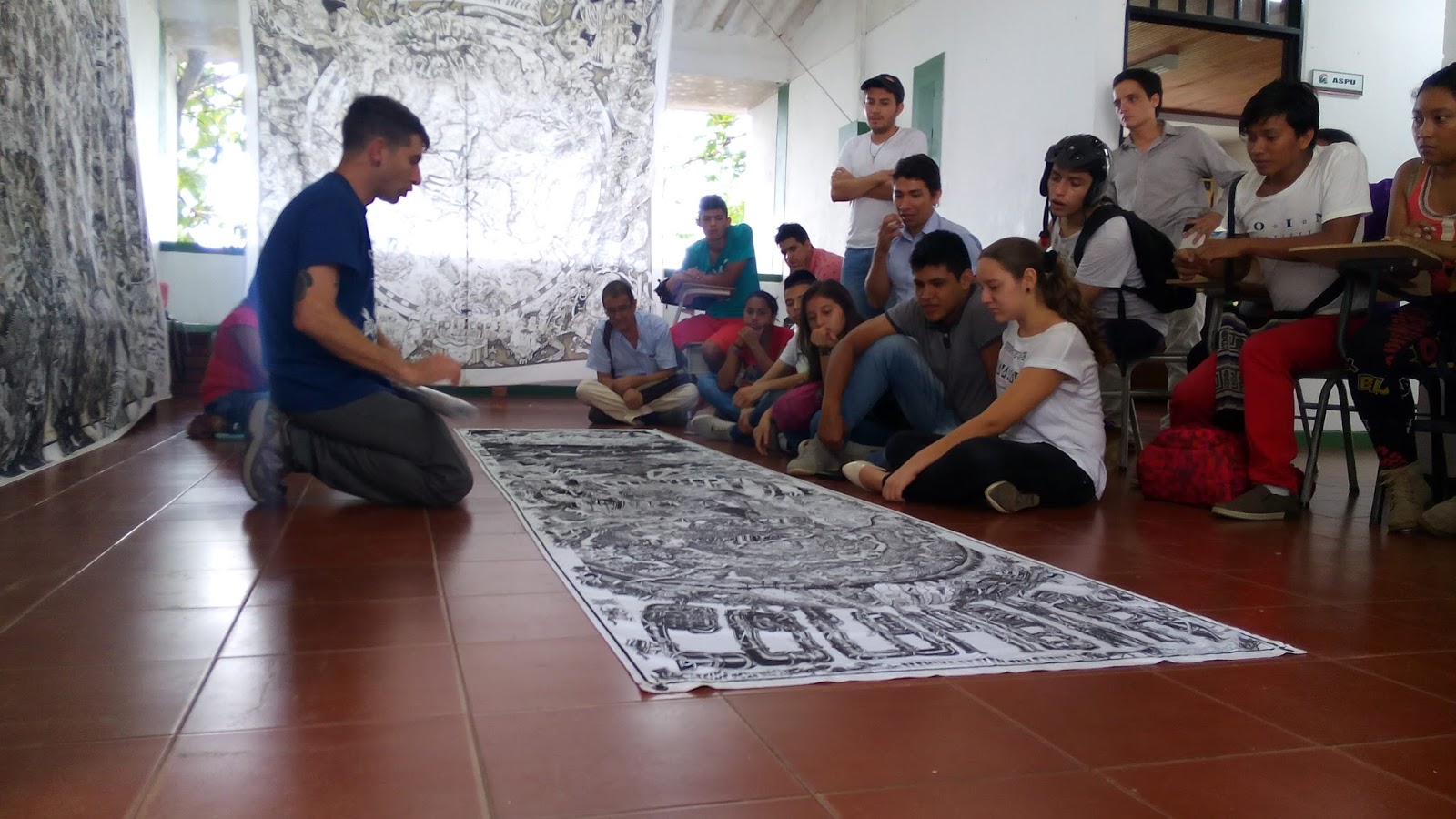
Amazonia]. In Jean Piaget there is never a lack of students; we worked this
time with all of the students from grades 5-11, who were drawn to the
illustrations and their meanings and gave detailed explanations of subjects
such as neoliberalism, extraction, identity, and culture. For two days we worked
with the ¡Mesoamérica Resiste! and Plan Colombia graphics with the students of
Jean Piaget grounding each concept in what is happening locally.
Like the first time, the places where we
were most able to share the work were the Instituto Educativo Jean Piaget (Jean
Piaget Educational Institute) and the Universidad de la Amazonia [University of
Amazonia]. In Jean Piaget there is never a lack of students; we worked this
time with all of the students from grades 5-11, who were drawn to the
illustrations and their meanings and gave detailed explanations of subjects
such as neoliberalism, extraction, identity, and culture. For two days we worked
with the ¡Mesoamérica Resiste! and Plan Colombia graphics with the students of
Jean Piaget grounding each concept in what is happening locally. In the University of Amazonia we were able
to share different spaces with different groups, including the Cabildo Indígena
Estudiantil (Indigenous Student Council), the Consejo Estudiantil (Student
Council), and many students and professors from all departments. The last night
in the university, the same hall in front of the library where ¡Mesoamérica
Resiste! was inaugurated a few years ago served again as the space to present ¡Mesoamérica
Resiste! and Plan Colombia. This time the workshop coincided with the closure
of the library which worked in our favor since a large amount of people had to
pass in front of the banners during the workshop in order to leave… this led to
more than one sticking around for the workshop. In each space there was a good
reception and contact information was exchanged to coordinate future workshops
on the graphics campaigns.
In the University of Amazonia we were able
to share different spaces with different groups, including the Cabildo Indígena
Estudiantil (Indigenous Student Council), the Consejo Estudiantil (Student
Council), and many students and professors from all departments. The last night
in the university, the same hall in front of the library where ¡Mesoamérica
Resiste! was inaugurated a few years ago served again as the space to present ¡Mesoamérica
Resiste! and Plan Colombia. This time the workshop coincided with the closure
of the library which worked in our favor since a large amount of people had to
pass in front of the banners during the workshop in order to leave… this led to
more than one sticking around for the workshop. In each space there was a good
reception and contact information was exchanged to coordinate future workshops
on the graphics campaigns. Two new spaces that made themselves
available for workshops were the Montañita branch of the Agrosolidaria
[Agrosolidarity] store and the Vicaría del Sur [Southern Vicar] in the
municipality of Morelia. For the first time, with Agrosolidaria, we were able
to get close to the Caqueteña federation of this national confederation that
was born at the beginning of 1994 as the Asociación para el Desarrollo
Sostenible [Association for Sustainable Development] (SEMILLAS), with an
administrative office in the municipality of Tibasosa, Boyacá. SEMILLAS started
the design and ratification of a Socio-Economic Solidarity Program which has sought
to transform the established economic relationships that generate low familial
earnings and unemployment, based in precarious forms of access to financial and
productive resources.
Two new spaces that made themselves
available for workshops were the Montañita branch of the Agrosolidaria
[Agrosolidarity] store and the Vicaría del Sur [Southern Vicar] in the
municipality of Morelia. For the first time, with Agrosolidaria, we were able
to get close to the Caqueteña federation of this national confederation that
was born at the beginning of 1994 as the Asociación para el Desarrollo
Sostenible [Association for Sustainable Development] (SEMILLAS), with an
administrative office in the municipality of Tibasosa, Boyacá. SEMILLAS started
the design and ratification of a Socio-Economic Solidarity Program which has sought
to transform the established economic relationships that generate low familial
earnings and unemployment, based in precarious forms of access to financial and
productive resources. Today the Agrosolidaria Confederation has
four departmental federations and five departmental branches with core areas of
work such as: fair trade, the agro-ecological school, community finances,
agro-solidarity heirs, rural tourism, and various publications. In Caquetá, there are eight
branches: Florencia, Montañita, Belén de los Andaquíes, Valparíso, La Unión
Penaya, El Doncello, and Puerto Rico. The people who
participated were the members of the Montañita branch that live in Florencia –
above all, the young farmers who currently live in the city but have their
roots and another life in the countryside too. The shop closed and with
everyone attentive we began to explore the banners in a small group, looking at
scenes like the party, the birth cave, the market and the beehive. In the store
we were able to see the individual production line that this branch has of
Amazonian coffee and chocolate grown, processed and packaged by the families
associated with the Vereda Alto Quebradón [Upper Quebradón community] and
brought directly to consumers in Florencia without the need for intermediaries.
Today the Agrosolidaria Confederation has
four departmental federations and five departmental branches with core areas of
work such as: fair trade, the agro-ecological school, community finances,
agro-solidarity heirs, rural tourism, and various publications. In Caquetá, there are eight
branches: Florencia, Montañita, Belén de los Andaquíes, Valparíso, La Unión
Penaya, El Doncello, and Puerto Rico. The people who
participated were the members of the Montañita branch that live in Florencia –
above all, the young farmers who currently live in the city but have their
roots and another life in the countryside too. The shop closed and with
everyone attentive we began to explore the banners in a small group, looking at
scenes like the party, the birth cave, the market and the beehive. In the store
we were able to see the individual production line that this branch has of
Amazonian coffee and chocolate grown, processed and packaged by the families
associated with the Vereda Alto Quebradón [Upper Quebradón community] and
brought directly to consumers in Florencia without the need for intermediaries.
 In Morelia we were with a network of young
people from all the municipalities of the south of Caquetá, organized by the Vicaria
del Sur de la Diócesis de Florencia [Southern Vicar of the Diocese of
Florencia]. This was the only space in which it was not necessary to present
the banners; instead we were able to realize the activity with the methodology
of collective analysis with a group of approximately 50 young people ranging
from 10-17 years of age.
In Morelia we were with a network of young
people from all the municipalities of the south of Caquetá, organized by the Vicaria
del Sur de la Diócesis de Florencia [Southern Vicar of the Diocese of
Florencia]. This was the only space in which it was not necessary to present
the banners; instead we were able to realize the activity with the methodology
of collective analysis with a group of approximately 50 young people ranging
from 10-17 years of age.  After their time spent analyzing the work, all the
students gave their presentations of the scenes, fully understanding concepts
like colonization and neoliberal globalization, the representations of
ancestors with spirits and ghosts, the body as a territory, and the importance
of the assembly in decision making. The coordinators of the youth programs grounded
the concepts in what is going on locally and talked about how the creation of
the highway Marginal de la Selva [Border Highway of the Jungle] has impacted
the culture, economy, and ecosystems of the region. They related how their
lives in Yurayaco changed, and how it was possible to live well, albeit with
difficulties, before the highway. To emphasize the trajectory of deep formation
these young people have the workshop culminated with three groups presenting a
performance or expressive action representing their favorite scenes of the
graphic; for all the groups the scene that repeated was that of “the assembly.”
After their time spent analyzing the work, all the
students gave their presentations of the scenes, fully understanding concepts
like colonization and neoliberal globalization, the representations of
ancestors with spirits and ghosts, the body as a territory, and the importance
of the assembly in decision making. The coordinators of the youth programs grounded
the concepts in what is going on locally and talked about how the creation of
the highway Marginal de la Selva [Border Highway of the Jungle] has impacted
the culture, economy, and ecosystems of the region. They related how their
lives in Yurayaco changed, and how it was possible to live well, albeit with
difficulties, before the highway. To emphasize the trajectory of deep formation
these young people have the workshop culminated with three groups presenting a
performance or expressive action representing their favorite scenes of the
graphic; for all the groups the scene that repeated was that of “the assembly.” The week passed rapidly though before
leaving we took a dip in the Hacha River and whatever we didn’t achieve in this
visit remains pending for a quick return later this year. Thanks to A la Orilla
del Río, it was possible to put the workshops on with short notice and we hope
to return soon and to be here for a month traveling around the department. Other
branches of Agrosolidaria, the communities of the students of Cabildo Indígena
Estudantil, and processes of communication and of territorial defense that are
interested in receiving and organizing a workshop space for sharing the
graphics campaigns of the Beehive Design Collective and Movimiento Ríos Vivos in
Amazonian Caquetá please get in touch with us via alaorilladelrio & polinizaciones
@gmail.com.
The week passed rapidly though before
leaving we took a dip in the Hacha River and whatever we didn’t achieve in this
visit remains pending for a quick return later this year. Thanks to A la Orilla
del Río, it was possible to put the workshops on with short notice and we hope
to return soon and to be here for a month traveling around the department. Other
branches of Agrosolidaria, the communities of the students of Cabildo Indígena
Estudantil, and processes of communication and of territorial defense that are
interested in receiving and organizing a workshop space for sharing the
graphics campaigns of the Beehive Design Collective and Movimiento Ríos Vivos in
Amazonian Caquetá please get in touch with us via alaorilladelrio & polinizaciones
@gmail.com.